Claim Your Flexible Financing
Avoid These 5 Costly Coastal Remodeling Mistakes That Can Ruin Your Waterfront Property
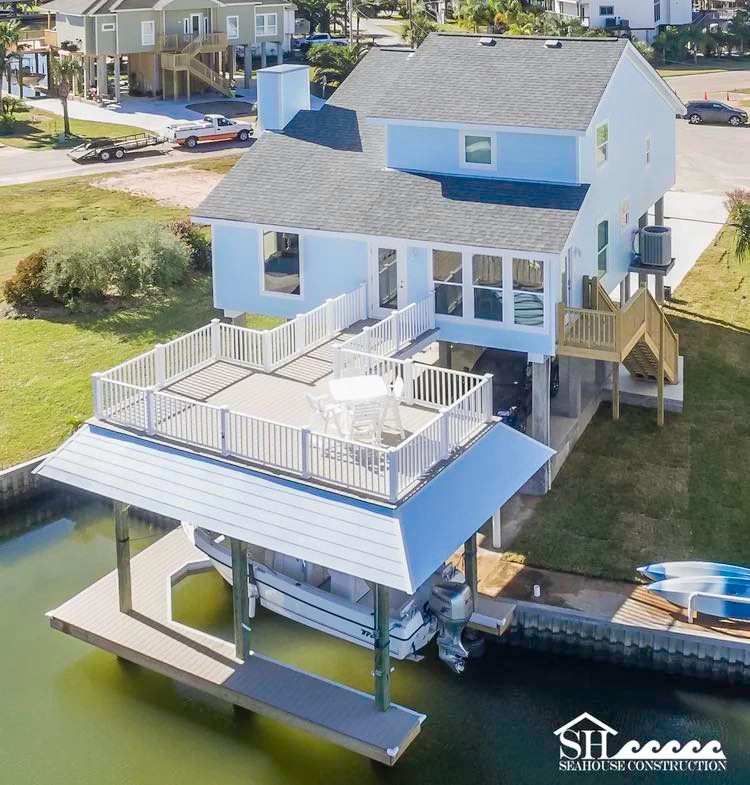
Choosing Standard Materials in a Saltwater Environment
Property owners often select materials based on inland construction standards, unaware that Galveston’s saltwater exposure accelerates deterioration at three to five times the normal rate. Standard lumber, untreated metal fasteners, and conventional paint formulations begin degrading within months when subjected to constant salt spray and moisture. This mistake typically stems from attempting to control costs by purchasing materials designed for Houston’s inland neighborhoods rather than Gulf Coast conditions.
The consequences manifest quickly along the waterfront. Wooden deck boards warp and splinter within two years instead of lasting a decade. Metal railings develop rust stains that bleed into adjacent surfaces. Exterior paint bubbles and peels after a single hurricane season, exposing underlying materials to accelerated rot. Homeowners who initially saved fifteen to twenty percent on material costs face complete replacement expenses within three to four years, ultimately spending double or triple their original budget.
Successful coastal construction requires materials engineered for marine environments. Composite decking resists moisture absorption and salt damage. Stainless steel or specially coated fasteners prevent corrosion. Marine-grade sealants and paints create protective barriers against humidity and salt intrusion. When planning your exterior remodeling service, selecting materials rated for saltwater exposure adds upfront cost but eliminates recurring replacement cycles. Our custom construction service incorporates marine-grade specifications throughout every waterfront project, ensuring your investment withstands the demanding conditions along League City and Galveston’s shoreline for decades rather than just a few seasons.
Overlooking Site-Specific Drainage Systems
Waterfront properties in the Galveston and League City area face unique water management challenges that standard subdivision drainage cannot address. Many remodeling projects proceed without analyzing how storm surge, tidal fluctuations, and heavy rainfall interact with the existing grade and foundation. Contractors accustomed to inland work often install gutters, downspouts, and grading patterns that prove inadequate when a Gulf storm delivers six inches of rain in three hours or when king tides push water levels eighteen inches above normal.
The results create expensive structural problems. Water pools against foundation walls, infiltrating through microscopic cracks and eventually compromising structural integrity. Crawl spaces flood repeatedly, fostering mold growth and wood rot in floor joists. Improperly graded yards channel runoff toward the home rather than away, saturating the soil and causing differential settling that cracks slabs and creates uneven floors. Homeowners discover these issues only after observing persistent dampness, musty odors, or visible foundation movement, at which point repair costs escalate into five-figure territory.
Effective coastal drainage requires engineered solutions tailored to your specific elevation, soil composition, and exposure to tidal influence. French drains positioned strategically around the foundation perimeter intercept groundwater before it reaches vulnerable areas. Grading plans that account for both rainfall and storm surge direct water to appropriate collection points. Sump pump systems provide backup protection during extreme weather events. Our remodeling construction approach begins with thorough site assessment to identify water flow patterns unique to your property. We design drainage infrastructure that protects your investment during both routine thunderstorms and major coastal weather systems.
Underestimating Structural Reinforcement Needs
Homeowners frequently focus remodeling budgets on aesthetic upgrades while minimizing investment in structural reinforcements that protect against hurricane-force winds. This oversight proves particularly costly along the Texas Gulf Coast, where wind events capable of generating sustained speeds above one hundred miles per hour occur with statistical regularity. Many assume that existing roof sheathing, window frames, and exterior attachments meet current wind-load requirements, not realizing that building codes have strengthened significantly over the past two decades.
When tropical systems make landfall, inadequately reinforced additions become the first casualties. Roof panels peel away from insufficient fastener schedules, allowing water intrusion that destroys interior finishes and personal property. Windows without impact-resistant glazing shatter, creating dangerous projectiles and exposing the home’s interior to destructive wind pressure. Decorative columns, pergolas, and other architectural features detach and become airborne hazards. Insurance adjusters frequently attribute damage to inadequate construction rather than unavoidable storm forces, leaving homeowners responsible for tens of thousands in repair costs.
Proper wind protection integrates into the remodeling design from the initial planning phase. Hurricane straps connect roof trusses to wall plates, creating continuous load paths that resist uplift forces. Impact-rated windows and doors maintain the building envelope’s integrity even when struck by debris. Exterior attachments such as decks and covered porches require engineered connections calculated for your property’s specific wind exposure category. Our exterior remodeling contractor services incorporate the structural reinforcements necessary to meet current wind-load standards, ensuring your renovated waterfront property withstands the weather patterns that define coastal living in this region.
Building Additions Without Foundation Analysis
Coastal soil conditions along Galveston Bay create foundation challenges distinct from inland Texas properties. The combination of expansive clay soils, high water tables, and seasonal moisture fluctuations causes continuous ground movement that affects structural stability. Homeowners planning room additions or second-story expansions often proceed without evaluating how new loads will interact with existing foundation systems or how differential settlement between old and new construction will create structural stress points.
The consequences appear gradually but inevitably. Cracks develop at the junction between original construction and additions as the structures settle at different rates. Doors and windows in new sections become difficult to operate as frames shift out of square. Floor elevations diverge, creating tripping hazards and visible separations at transition points. In severe cases, inadequate foundation design allows entire additions to separate from the main structure, requiring expensive underpinning and structural repairs that exceed the original construction cost.
Successful additions require foundation engineering that accounts for soil composition, groundwater levels, and anticipated settlement patterns. Soil bearing capacity tests determine appropriate footing dimensions and reinforcement requirements. Pier and beam systems extend to stable soil strata below the active zone where seasonal moisture changes cause expansion and contraction. Proper connection details between new and existing foundations accommodate expected movement without creating structural damage. When you work with an interior remodeling contractor experienced in coastal conditions, your project begins with geotechnical assessment that informs foundation design, preventing the settlement issues that compromise so many waterfront additions in the League City and Galveston area.
Creating Sealed Environments in High-Humidity Climates
Modern energy-efficiency standards emphasize tight building envelopes that minimize air infiltration, an approach that works well in dry climates but creates serious problems in coastal environments with persistent humidity. Homeowners invest in sealed windows, continuous vapor barriers, and spray foam insulation without incorporating the mechanical ventilation necessary to manage moisture levels. The result creates perfect conditions for hidden mold growth, wood decay, and indoor air quality problems that develop invisibly within wall cavities and attic spaces.
The damage remains concealed until it becomes extensive. Mold colonies establish themselves on wooden framing members, drywall backing, and insulation materials, releasing spores that trigger respiratory problems and allergic reactions. Condensation trapped within wall assemblies saturates insulation, reducing its effectiveness and promoting rot in structural lumber. Metal electrical components corrode. The musty odors and visible mold patches that eventually alert homeowners to the problem indicate that contamination has already spread throughout multiple building cavities, requiring remediation costs that often exceed twenty thousand dollars.
Coastal construction must balance energy efficiency with active moisture management. Properly designed ventilation systems create controlled air exchanges that remove humid air before condensation occurs. Dehumidification equipment maintains indoor humidity below the threshold where mold growth becomes sustainable. Strategic vapor barrier placement prevents moisture migration into temperature-sensitive areas while allowing drying when conditions permit. Our kitchen and bathroom remodeling service incorporates ventilation solutions engineered for Gulf Coast humidity levels, protecting your investment from the moisture-related deterioration that affects improperly ventilated waterfront properties throughout this region.